
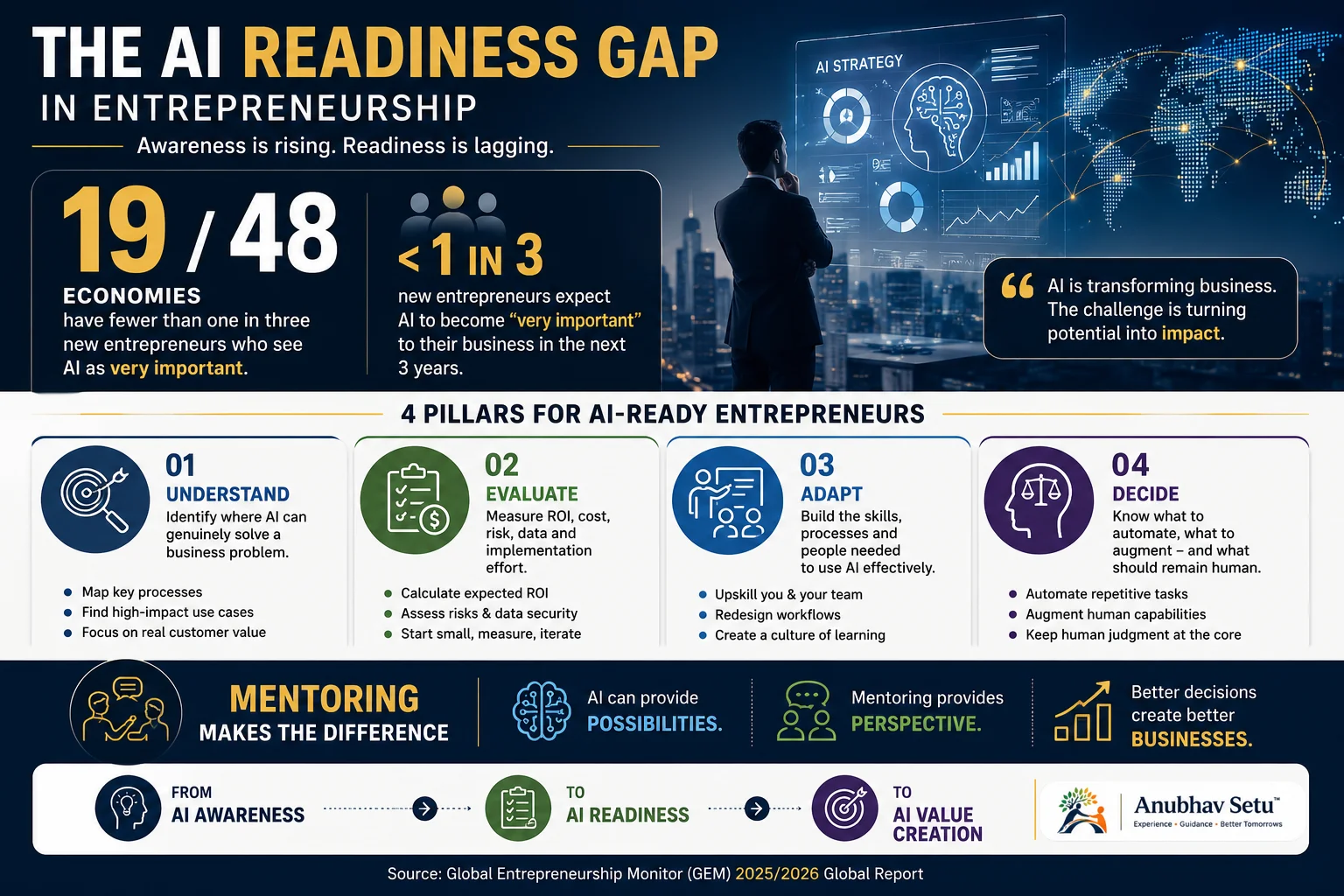
AI has become one of the biggest conversations in business.
Entrepreneurs hear about AI-powered marketing, automation, intelligent analytics, AI agents, personalized customer experiences and productivity gains almost every day.
Yet there is a paradox hiding underneath the excitement:
Awareness of AI is growing faster than entrepreneurial confidence in using it.
According to the Global Entrepreneurship Monitor (GEM), in 2024/25, fewer than 30% of early-stage entrepreneurs in 36 of 49 economies considered AI “very important” to their business strategy.
A year later, the conversation is shifting.
GEM's latest findings point toward an emerging AI Readiness Gap: in 19 of 48 economies, fewer than one in three new entrepreneurs expect AI to become very important to their business in the near term.
So perhaps the real question is no longer:
“Do entrepreneurs believe in AI?”
The more important question is:
“Do entrepreneurs know how to make AI relevant to their business?”
From AI Uncertainty to AI Readiness
For a technology entrepreneur, experimenting with AI may feel natural.
But consider a traditional manufacturer, retailer, family-owned enterprise, consultant, local service provider or first-generation entrepreneur.
Their questions are different:
Where can AI actually create value in my business? Should I automate this process or keep human control? Which AI tools are worth paying for? How do I calculate the ROI? What happens to customer data and confidentiality? Do my employees have the skills to use AI? How do I introduce AI without disrupting the business? What if my competitors adopt it before I do?
These aren't technology questions alone.
They are business decision questions.
And this is where the AI conversation becomes much more interesting.
The AI Value Gap
The next challenge for entrepreneurs may not be AI adoption.
It may be AI value realization.
An entrepreneur can subscribe to ten AI tools and still gain very little business value.
AI does not automatically create innovation. AI does not automatically improve strategy. AI does not automatically increase profitability.
The value comes from knowing where AI belongs—and where it doesn't.
This creates three distinct stages:
AI Awareness “I know AI is changing business.” AI Readiness “I understand where AI could apply to my business.” AI Value Creation “I can measure how AI improves revenue, productivity, customer experience, cost or decision-making.”
Many entrepreneurs are somewhere between Stage 1 and Stage 2.
That gap matters.
Why Mentoring Matters More in the AI Era
We often think mentoring is about sharing experience. But in an AI-driven economy, mentoring can become something much more important:
Helping people make better decisions in an environment of unprecedented choices.
An entrepreneur doesn't necessarily need someone to tell them:
“Use AI.” They need someone to help them ask:
“Why should I use AI here?” And:
“What is the business problem I am actually trying to solve?” That distinction is critical. Because the future may not belong simply to entrepreneurs who use the most AI.
It may belong to entrepreneurs who make the best decisions about where AI should—and should not—be used.
The New Entrepreneurial Advantage
The competitive advantage of the future could therefore become a combination of:
Human Experience + AI Capability + Trusted Mentorship
AI can provide information. AI can generate possibilities. AI can accelerate execution.
But judgment still matters.
Entrepreneurs need context. They need someone to challenge assumptions. They need someone who can connect technology with their specific industry, stage, resources and ambitions. And sometimes, the most valuable advice may be:
“Don't use AI for this.”
From Information to Informed Decisions
This is the larger opportunity I see. We are entering an economy where information is becoming abundant.
But informed decision-making is not.
Whether it is entrepreneurship, career planning, studying abroad, global mobility or building a new business, people increasingly have access to more information than ever before.
The challenge is knowing:
What applies to me? What should I believe? What should I ignore? What should I do next?
That is the space where mentoring, counselling and real-world experience can create enormous value.
AI may provide the answers.
But humans still need help asking the right questions.
That is why I believe the next generation of entrepreneurial support should not be AI versus humans.
It should be:
AI + Human Experience + Trusted Mentorship.
Because the future doesn't belong to those who simply adopt technology.
It belongs to those who learn how to make better decisions with it.
The Role of Experienced Guidance
This is where the wisdom of those who have "survived the year you are in" becomes invaluable.
Platforms like Anubhav Setu bridge this gap. Instead of leaving founders to navigate technical noise in isolation, experience-based Business Mentoring pairs growing business owners with seasoned mentors—retired CEOs, manufacturers, and operators who know how to separate genuine operational leverage from fleeting trends.
True mentorship isn't about rushing to adopt every new innovation. It is about interpreting technology through the lens of timeless fundamentals: cash flow, customer retention, and sustainable growth.
Are you navigating tech adoption or strategic uncertainty in your business? Let’s discuss how perspective from those who have walked the path before can help cut through the noise.
#Entrepreneurship #ArtificialIntelligence #AI #BusinessStrategy #Mentoring #Innovation #SME #Startups #DigitalTransformation #FutureOfWork #Leadership #AnubhavSetu #IntergenerationalMentoring #BusinessMentoring #Entrepreneurship #BusinessLeadership